Solutions
Real-World Data (RWD) Solutions for Oncology Drug Development in Asia
ApreNet provides Asia-focused RWD solutions across the full development continuum—from early feasibility through evidence generation, external control strategy, pragmatic trial planning, and model-informed drug development.
Core RWD Services
Feasibility Assessment
Evaluate patient populations, variable availability, treatment patterns, and data extraction feasibility across Asian institutions for planned RWD studies.Treatment Patterns and Sequencing Analysis
Characterize real-world drug adoption, treatment sequencing, and line-of-therapy patterns in Asian clinical practice using longitudinal electronic health record (EHR) data.External Control Arm Strategy
Support the design of fit-for-purpose external comparator cohorts using retrospective EHR-derived RWD for single-arm or non-randomized oncology development programs.
Advanced RWD Services
Pragmatic Trial Planning
Support prospective effectiveness studies in routine care settings to improve generalizability and real-world patient representation.Model-Informed Strategy
Integrate EHR-derived RWD with pharmacometrics, exposure-response analysis, tumor dynamics modeling, and simulation-based approaches where appropriate to support dose optimization and oncology development decision-making.Drug Repurposing & Label Expansion
Support Learn-Confirm strategies that use EHR-derived RWD to generate drug-indication hypotheses, evaluate signals using statistical, machine learning, and model-informed approaches, and inform pragmatic trial or prospective validation strategies.
Differentiated Capabilities
Model-Informed Strategy
Traditional RWD analyses in oncology describe treatment patterns and outcomes after they occur and heavily rely on overall survival data, which only captures the final "time-to-event" endpoint. ApreNet integrates the advanced model-informed RWD strategy to unlock the full predictive power of longitudinal RWD.
From Descriptive RWD to Predictive Drug Development
This means using longitudinal clinical data - including tumor size, treatment sequence, dosing information, safety events, and survival outcomes - to understand how disease and treatment effects evolve over time.
Pharmacometrics-Enabled RWD Strategy
ApreNet provides this model-informed approach, including pharmacometrics, as an advanced optional module to help support the following strategies:
- Earlier outcome prediction
- Dose optimization
- Exposure–response analysis
- Asian population bridging
- Virtual clinical trial simulation.
Strategic Value for Global Sponsors
Accelerated Predictability
Enables sponsors to predict long-term post-treatment survival outcomes at a significantly earlier stage of development.
Enhanced Proof-of-Concept (POC)
Provides robust, model-based evidence to optimize dose selection and virtual trial simulations before entering late-phase trials.
Regulatory Readiness
Aligns perfectly with the FDA's modern quantitative mandates (e.g., Project Optimus) by transforming messy EHR data into structured, model-ready variables.
Drug Repurposing & Label Expansion
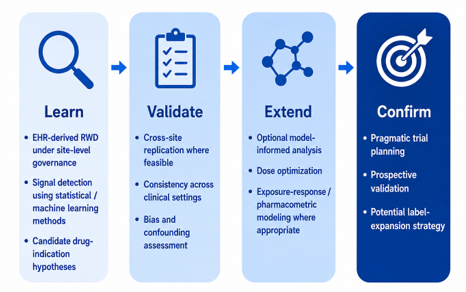
The approach follows a Learn–Confirm framework. In the Learn phase, EHR-derived RWD can be used to generate candidate drug–indication hypotheses through statistical and machine learning methods.
Candidate hypotheses may then be validated through replication across participating institutions, where feasible, to assess consistency across clinical settings and reduce the risk of site-specific signals.
Before confirmation, optional model-informed analyses, including dose optimization, exposure–response analysis, and pharmacometrics modeling, may be added to support dose selection, subgroup evaluation, and benefit–risk interpretation.
Promising signals may then be evaluated through pragmatic clinical trials or other prospective validation approaches to inform a potential label- expansion strategy.
Where appropriate, federated learning approaches may be used to support local model training without transferring institution-level source data.
RWD-Based Drug Repurposing: Learn–Confirm Framework
Learn
- EHR-derived RWD under site-level governance
- Signal detection using statistical/machine learning methods
- Candidate drug-indication hypotheses
Validate
- Cross-site replication where feasible
- Consistency across clinical settings
- Bias and confounding assessment
Extend
- Optional model-informed analysis
- Dose optimization
- Exposure-response/pharmacometrics modeling where appropriate
Confirm
- Pragmatic trial planning
- Prospective validation
- Potential label-expansion strategy