
Quality & Data Governance
Data Governance Workflow
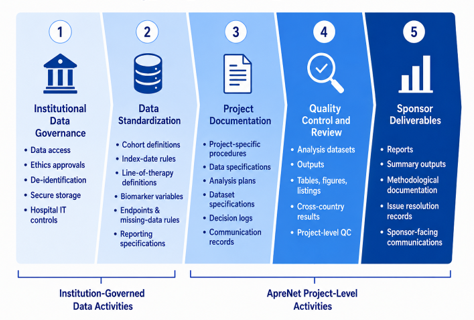
Institutional Data Governance
Data access, ethics approvals, de-identification, secure storage, and hospital IT controls are managed by the relevant source institution.
Data Standardization
Study-specific cohort definitions, index-date rules, line-of-therapy definitions, biomarker variables, endpoints, missing-data rules, and reporting specifications.
Project Documentation
Project-specific procedures, data specifications, analysis plans, dataset specifications, decision logs, and communication records.
Quality Control and Review
Analysis datasets, outputs, tables, figures, listings, and cross-country results are reviewed through project-level QC processes.
Sponsor Deliverables
Reports, summary outputs, methodological documentation, issue resolution records, and sponsor-facing communications.
Data Standardization Support
ApreNet may support study-specific data standardization, including:
- Common cohort definitions and index-date rules
- Line-of-therapy definitions
- Biomarker and genomic variable harmonization, where applicable
- Endpoint alignment and missing-data rules
- Country-level and pooled reporting specifications
Project-Level Procedural Documents
For applicable projects, ApreNet may maintain project-level procedural documents covering:
- Project management and oversight
- Document and records management
- Training and competency documentation
- Study-specific data management
- Statistical analysis and quality control review
- Issue management
Governance Principle
ApreNet does not treat hospital-origin electronic health record data as company-owned data.
For studies involving institutional data, data access and handling are governed by applicable hospital procedures, ethics approvals, data-use requirements, project agreements, institutional policies, and local regulations.
ApreNet's role is focused on project-level coordination, analysis planning, data specification, statistical and pharmacometrics methodology, quality control, documentation, and communication with project stakeholders, where applicable.