
Asia Real-World Data (RWD) Network
Asia-Based Oncology RWD Collaboration Network
ApreNet's Asia-based oncology RWD strategy is built on academic and clinical research collaborations across Asia, supported by scientific connectivity through the Asian Pharmacometrics Network (APN) and its 16-country academic network.
ApreNet is not limited to specific cancer types. Its electronic health record (EHR)-based RWD approach can be adapted across oncology areas where Asian patient populations, clinical practice patterns, molecular profiles, or treatment pathways may provide distinct scientific and development-relevant insights.
Asian populations may differ from Western populations in disease epidemiology, molecular profiles, treatment access, tolerability, comorbidity patterns, and real-world treatment sequencing. These differences make Asia-based RWD valuable for evaluating how global clinical-trial evidence translates into Asian routine practice and for identifying evidence gaps relevant to regional and global drug development.
Research-grade Asia-based EHR data can help pharmaceutical partners:
Biliary tract cancer and breast cancer are illustrative examples, not boundaries. Project scope is tailored to the sponsor's scientific question, target population, data availability, institutional approvals, and study objectives.ApreNet works through academic and clinical research collaborations. Data access and site participation are subject to project-specific approvals, contracts, ethics review, institutional governance, and applicable regulations at each participating institution.
The Asian Pharmacometrics Network
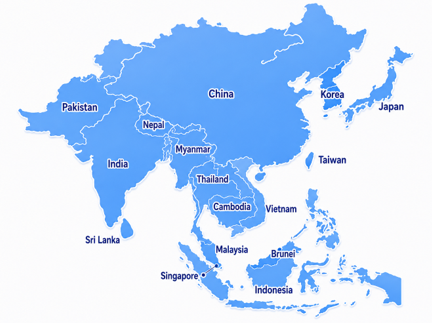
The Asian Pharmacometrics Network (APN), founded in 2017 by Kyungsoo Park, MD, PhD, provides an academic foundation for multi-country scientific collaboration across 16 Asian countries.
APN supports scientific connectivity across clinical pharmacology, pharmacometrics, oncology drug development, and real-world data methodology. Its academic activities include regional scientific exchange and publication in CPT: Pharmacometrics & Systems Pharmacology.
APN member countries include Korea, Japan, China, Taiwan, Singapore, India, Thailand, Malaysia, Vietnam, Indonesia, Pakistan, Myanmar, Sri Lanka, and Nepal, Cambodia, Brunei.
Institution-specific study participation and data access remain subject to local governance, contracts, ethics review, and applicable regulations.
Lead Academic Environment – Yonsei University Health System
Yonsei University Health System provides a major academic medical environment in Korea, with three hospital branches — Severance Hospital, Gangnam Severance Hospital, and Yongin Severance Hospital — and more than 3,000 beds.
The Yonsei clinical environment includes extensive oncology care experience and digital clinical data infrastructure that can support EHR-based clinical research, including study-specific data standardization where appropriate.
For projects involving Yonsei- or Severance-origin data, data access, extraction, de-identification, secure storage, and institutional IT controls are managed under applicable institutional governance, ethics approvals, contracts, data-use requirements, and hospital-level policies.
Representative Application — Breast Cancer RWD
Breast cancer illustrates the value of longitudinal EHR-based RWD for high-volume, treatment-rich oncology settings.
Asia-based breast cancer RWD can support treatment pattern analysis, real-world treatment sequencing, biomarker-defined subgroup evaluation, ADC-related development questions, and real-world effectiveness and safety assessment across clinical practice settings.
Key RWD questions
- Treatment sequencing across multiple lines of therapy
- Biomarker-defined subgroup evaluation
- Population-specific real-world effectiveness and safety
- ADC-related treatment patterns and outcomes
Representative Application — Biliary Tract Cancer RWD
Biliary tract cancer illustrates the value of Asia-based RWD for rare or Asia-enriched cancers where Western patient recruitment may be challenging, and disease burden may be higher in several Asian populations.
Current treatment standards in biliary tract cancer have been shaped by pivotal trials conducted largely in Western populations. Asia-based EHR data can help evaluate how pivotal trial evidence translates into Asian routine clinical practice.
Key RWD questions
- Development feasibility in Asian clinical settings
- Regional evidence generation
- Bridging between pivotal trial evidence and Asian routine practice
- Population-specific outcomes
A Note on Data Access and Governance
ApreNet supports research question development, study design, data standardization strategy, analysis planning, project-level governance, and sponsor-facing scientific communication in collaboration with participating institutions.
ApreNet does not function as a direct owner of hospital-origin EHR data. Data access, extraction, de-identification, analysis, transfer, and storage are governed at the institution and project level.
All multi-country RWD activities are subject to project-specific approvals, contracts, ethics review, institutional governance, site-level procedures, hospital IT controls, data-use agreements, and applicable data protection regulations.